Fertility treatment isn’t easy for many couples, but when considering IVF treatment abroad, the cost and reliability of Sri Lanka always surprise couples the most. Advanced technology, experienced and empathetic doctors, and a great support team make the facility some of the best in the world. World-class IVF labs, individual treatment designs, and affordable high success IVF surgery are a few reasons why many people choose Sri Lanka as their destination for quality and affordable reproductive care.
If you are comparing regional options, and are planning a medical trip, knowing the IVF Treatment Cost in Sri Lanka is important for a seamless trip and a peaceful mind. Knowing the total cost of the trip lets you focus on the real reason for your trip – starting a family. Knowing the total cost of the trip lets you focus on the real reason for your trip – starting a family. From planning your consultation to receiving medication and the final procedure, this guide outlines the total cost so you can best prepare for your trip.
What is IVF?
In Vitro Fertilization (IVF) is among the advanced fertility treatments, created to aid those that struggle to conceive a child naturally. The first step is to take special hormonal medications that stimulate the ovaries to produce multiple mature eggs. When the eggs should be ready to be harvested, they are taken out along with the woman’s ovaries.
Then, in a controlled laboratory setting, the eggs get combined with the sperm for fertilization to take place. The embryos created are tracked for a period of time, and the healthiest one is chosen to be implanted in the woman’s uterus, where it is hope that is can grow into a fully developed child.
A recommendation to try IVF is often given to those with blocked fallopian tubes, low sperm count, PCOS, endometriosis, or unexplained reasons of infertility. IVF often is the hopeful and reliable option that attempts to tailors parenthood through modern science and meticulous lab fertility care, and for many couples, is the better option to achieve a baby.

Why is IVF done?
IVF is done to help couples or individuals conceive when natural pregnancy becomes difficult or impossible due to medical or reproductive challenges. It is commonly recommended for women with blocked or damaged fallopian tubes, severe endometriosis, or ovulation disorders like PCOS.
It also helps when the male partner has low sperm count, poor sperm motility, or abnormal sperm shape. IVF is often used after other treatments such as medications or intrauterine insemination (IUI) have failed. It also supports couples facing unexplained infertility, where no clear cause is found. Additionally, IVF is chosen by those who need donor eggs, donor sperm, or wish to preserve fertility before cancer treatments. For many, IVF provides a guided, scientific pathway to pregnancy when natural conception isn’t happening, offering hope and a higher chance of success.
How to prepare for IVF treatment?
- Medical Consultation and Testing
Before moving forward with an IVF cycle, schedule a pre-IVF work-up appointment with a fertility specialist. Each partner will complete medical tests, including hormone tests, ovary reserve testing, semen analysis, and infectious disease testing. This allows the physician to customize an IVF treatment plan and optimize the chances of successful fertilization and a healthy embryo.
- Lifestyle Adjustments
Healthy lifestyle changes should be made several months, if not a year, prior to treatment. Immediately eliminate smoking and recreational drug use, as well as alcohol consumption. Incorporate a diet consisting of a healthy well-balanced diet with adequate color, vitamins, and proteins. Incorporate regular physical activity to help with weight management and stay within the target weight range. Relatively small changes can make a considerable difference.
- Mental and Emotional Preparation
IVF can be a highly emotional process. Mental notes should be made as a couple to prepare for this process. Support via counselling, meditation, and support groups can help manage this process. Communication with your partner is critical in order to provide emotional support to one another. Remaining positive and patient is important in order to cope with the stresses that will accompany this process.
- Medication and Hormonal Preparation
IVF in Sri Lanka, physicians prescribe hormonal medicines that help the ovaries get stimulated to get ready to extract many eggs. There are strict instructions that the patients have to follow, such as taking prenatal vitamins and folic acid, to get the body ready for the pregnancy. Egg growth is the aim of the medication schedules, and adherence multiplies the chances of achieving success with the IVF cycle.
- Timing and Scheduling
Timing the IVF cycle is crucial in Sri Lanka and the global practice because it is based on the menstrual cycle. Egg retrieval, embryo transfer, and other procedures must be done at the correct timing to avoid wasting the IVF cycle. For recovery and other appointments, proper planning down to the minute is essential, and patients are encouraged to take time off work to avoid stress, as the procedures and tasks are synced to hit the most productive points in the cycle.
- Financial Planning
Before starting the IVF journey, the financial planning of assisted reproductive technology in Sri Lanka should be done. Many expenses have to be considered when budgeting. The aim is to decrease the expenses in the cycle. An option, of course, is to forego ICSI or embryo freezing, also the medications, and other procedures, so looking at the stress of expenses, it is very important to plan so that there is financial convenience in budgeting for a focus on treatment without the culture of expenses influencing it.
How does IVF work?
IVF (In Vitro Fertilization) works by helping the egg and sperm meet outside the body in a controlled laboratory environment. Once fertilization happens and an embryo forms, the embryo is placed into the uterus to grow naturally into a pregnancy.
The process is completed in several organised steps:
- Ovarian Stimulation
In the process of IVF, the women have to go through the process of having their hormones injected so that their ovaries can produce more than the single egg. This makes the chances of getting the egg(s) fertilized higher. Doctors keep tracs of the the eggs through growth and development via ultrasounds and blood tests.
- Monitoring and Egg Maturation
The doctors keep watch over the eggs development with the ultrasounds and blood tests. The eggs have to reach a certain magnitude before a trigger shot is administered to help the eggs to fully mature. Timing is everything because the eggs have to be taken out before the woman ovulates. This step makes sure the eggs are set to be taken out.
- Egg Retrieval
Slight anaesthesia is given, and while you are out of it, a thin needle is put through the vaginal wall to obtain eggs from the ovaries. It takes about 10 to 20 minutes, and a lot of women do not feel anything. The eggs that are retrieved are taken to a lab that contains signs of them being mature.
- Getting Sperm Samples
Sperm samples are also collected on the same day as the egg retrieval. A lab first processes the sample, isolating the healthiest, most motile, and more active sperm. The IVF procedure works best with the most vigorous sperm as they have a better chance at fertilizing an egg and developing it into a viable embryo.
- Fertilization
Fertilization occurs in the lab, and the first step is mixing the sperm with the eggs using an ICSI method. ICSI involves injecting a sperm directly into the egg, which is more expensive but often more effective. The fertilized eggs are then watched very closely and with great care for any signs of healthy cell division. This is a critical step, as the formation of healthy embryos depends on proper, sustained cell division.
- Developing Embryos
Once fertilization is complete, the embryos are placed in a specialization incubator that simulates the human body. This is done because, for the next 3-5 days, the embryos will be the most active and have an ideal environment. Only a few of the embryos will make it this far into the process. To ensure all of the best embryos are selected, a trained embryologist will monitor the process to select the best quality embryos to be transferred.
IVF Process Step-by-Step
The following table describes the process of IVF in Sri Lanka:
| Step | What Happens |
| 1. Consultation | Meet the fertility doctor. Basic tests are done to understand your body’s needs. |
| 2. Hormone Injections | Women take hormone injections for 10–12 days to produce multiple eggs. |
| 3. Egg Retrieval | Eggs are collected from the woman’s ovaries using a small needle (painless with light sedation). |
| 4. Sperm Collection | The male partner gives a sperm sample. Donor sperm can be used if needed. |
| 5. Fertilisation | Eggs and sperm are mixed in the lab. If fertilisation happens, embryos are formed. |
| 6. Embryo Culture | Embryos grow in the lab for 3–5 days. The best quality embryos are selected. |
| 7. Embryo Transfer | One embryo is placed into the woman’s uterus. It’s a simple and painless procedure. |
| 8. Pregnancy Test | After 10–14 days, a blood test is done to check if pregnancy has started. |
What is the IVF Cost in Sri Lanka?
Due to affordable prices and high-quality care, IVF in Sri Lanka has gained popularity among those seeking fertility treatments. A standard IVF cycle (using your own eggs and sperm) will cost an average of USD 4,400 to USD 5,100 (approximately LKR 800,000 to LKR 950,000), depending on the clinic and services offered, but in some cases, a clinic may charge usd 6,000 for a standard cycle in a more expensive package.
Over the standard IVF cycle, additional procedures (ICSI, donor eggs, donor sperm, embryo freezing, genetic testing) will increase the cost, and clinics may monitor and manage these. For couples in need of more advanced fertility care, Sri Lanka offers a professional, modern, and compassionate approach to the whole process.
| Treatment/Service of IVF in Sri Lanka | Cost Range of IVF in Sri Lanka (USD) |
| Basic IVF Package | 4,400 – 5,100 |
| IVF with ICSI | 4,000 – 6,000 |
| IVF with Egg Donation | 5,300 – 6,100 |
| IVF with Surrogacy | Not widely available / varies |
| IVF Cycle (base cost) | 3,000 – 5,000 |
| Medications | 1,000 – 3,000 |
| ICSI (if needed) | 1,500 – 2,500 |
| Embryo Freezing & Storage | 500 – 1,500r |
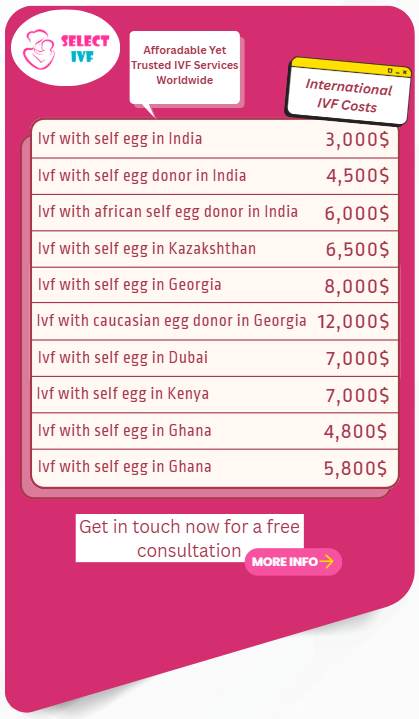
The following is the table of expenses involved in the procedure of IVF packages at Select IVF Sri Lanka:
| Other Countries | Cost Range (USD) |
| IVF Cost in India | 1,500 – 3,000 |
| IVF Cost in UAE (Dubai) | 4,000 – 7,000 |
| IVF Cost in USA | 12,000 – 15,000 |
| IVF Cost in Russia | 3,000 – 6,000 |
| IVF Cost in Turkey | 3,500 – 6,500 |
| IVF Cost in Ukraine | 2,500 – 5,000 |
What is the success rate of IVF in Sri Lanka?
In Sri Lanka, the success rate for IVF is around 80 to 97%. It all depends on factors like the age of the couple, especially women, the number of IVF attempts involved to achieve success of IVF, the usage of advanced technology and the latest techniques that can increase the success rate, and the experience and expertise of fertility doctors or IVF specialists.
The following table helps you to understand the success rate of IVF in Sri Lanka:
| IVF treatment in Sri Lanka | Success rates of IVF in Sri Lanka |
| IVF with self-eggs | 60 to 90% |
| IVF with self-sperm | 65 to 86% |
| IVF with donor eggs | 70 to 85% |
| IVF with donor sperm | 73 to 87% |
| IVF with FET | 60 to 65% |
| IVF with ICSI | 50 to 85% |
The following table lets you understand the success rates based on age:
| The success rate of IVF based on age | The success rate of IVF in Sri Lanka |
| women with age between 20 to 25 years | Up to 98% |
| women with age between 25 to 35 years | Up to 95% |
| women with age between 35 to 40 years | Up to 73% |
| women with age between 40 to 45 years | 40 to 70% |
| women aged between 45 to 50 years | 35 to 60% |
What influences the IVF success rate in Sri Lanka?
The factors that influence the IVF success rate in Sri Lanka include the following:
Woman’s age: The age of the woman can influence the success rate of IVF in Sri Lanka. Women of younger ages have a higher chance of achieving pregnancy, while older women have a lower chance. As age increases, the quality of eggs decreases.
Advanced technology: The use of advanced reproductive technology can increase the success rate of IVF in Sri Lanka.
Doctor’s expertise: The doctor’s expertise and skill can influence the success rate of IVF in Sri Lanka. The higher the experience in the fertility industry, the higher the chances of conception through artificial insemination.
Patient’s overall condition: The patient’s health and overall personal condition can influence the IVF success rate.
The complexity of the case: The complexity of the case also matters the most when it comes to influencing the success rate of IVF in Sri Lanka.
Number of IVF attempts: Sometimes it is not possible to get successful results on the first attempt of IVF. Multiple attempts are required to get successful results.

What should you consider when selecting the top IVF clinic in Sri Lanka?
We understand how difficult it becomes to select the best option for your infertility treatment, but do not get tense, as one of the best options is going to be suggested to you where the patient collaborates with highly experienced and qualified doctors. The patient will find it comfortable as the staff will always stand by them, away from all the worries that come to their mind. We offer all types of infertility treatment, so contact us today! To start, consider the following factors while selecting a location:
i. The patient-focused assistance of the centre
ii. Professionals with extensive education and experience
iii. Infrastructure that is well-built for maximum comfort and happiness
iv. The entire medical staff treats you with respect
v. Assists you throughout the entire process from the beginning
vi. Offers transparent fees and processes
You have the option of choosing IVF for all of these! So, reach out to us at +91- 8447592299 | Email ID: info@www.selectivf.com
Why pick Select IVF for IVF in Sri Lanka?
Several numbers of infertile couples trusted the Select IVF for their bright future. We care for every patient who has issues of infertility. We understand the phase of infertility, and that’s why we want to assist you in your dream of achieving parenthood. The prices of IVF treatment are reasonable at our centre, we ensure the highest success rates, we keep transparency and ensure personalised care and support to our patients. Get the treatment from our clinic and make your life stress-free by hearing the giggling of your newborn.
Here’s why Select IVF is best for IVF treatment in Sri Lanka:
- The high success rate of IVF and other infertility treatments
- Several infertility treatments for different infertility issues
- Use of cutting-edge technologies
- Equipped with highly skilled and educated doctors
- Affordable prices for IVF and other infertility treatments
- Ensures utmost comfort and support during the procedure
Conclusion
IVF in Sri Lanka provides a unique combination of decent quality, good technology, and low prices, which makes it appealing for couples dealing with infertility. IVF Treatment Cost in Sri Lanka ranges from 4,400 – 6,100 dollars for standard procedures, and cuts like egg donation procedures are priced a little higher. This makes it cheaper than a good amount of other countries.
Specialized procedures like Embryo freezing, ISCI, and and donor embryos do increase the overall costs of IVF, but couples are able to truly appreciate the modern care facilities and individual attention over the duration of the IVF procedures. A good amount of people are able to view this from IVF clinics in Sri Lanka and positively view this from a good and decent IVF clinics. These individuals can also positively alter the view of IVF clinics in Sri Lanka, to also be a beacon of hope for people.
Frequently Asked Questions (FAQs)
1. What is the average cost of a basic IVF cycle in Sri Lanka?
The average cost for a standard IVF cycle using your own eggs and sperm is around USD 4,400 to 5,100.
2. Does the IVF package include medications and monitoring?
Many clinics include medications, ultrasounds, and blood tests in their “all-in” IVF packages, but it’s important to confirm with the clinic.
3. How much does IVF with ICSI cost in Sri Lanka?
IVF with ICSI typically ranges between USD 4,000 and 6,000, depending on the clinic and treatment plan.
4. Is egg donation available for IVF in Sri Lanka, and what’s the cost?
Yes, egg donation is available in some clinics and usually costs around USD 5,300 to 6,100.
5. Can embryos be frozen, and what is the storage cost?
Yes, embryos can be frozen for future use, and storage costs range from USD 500 to 1,500 per year.
6. How does Sri Lanka compare to other countries in IVF cost?
IVF in Sri Lanka is generally more affordable than in many Western countries, offering high-quality care at lower costs while maintaining good success rates.
Read Also: