Surrogacy in India is one of the options for infertile couples to have a baby. When couples can’t get a baby through the natural process, they take the help of surrogacy. It’s an assisted reproductive technique that, with the help of artificial fertilisation, provides a baby.
Surrogacy has a complex process that includes the legal arrangements, egg retrieval, sperm collection, fertilisation, embryo transfer and pregnancy check. Due to this, people have a myth that it is one of expensive treatments to have a baby.
However, in reality, it’s not true. Surrogacy is one of the affordable treatments to treat infertility. Its cost is only up to 1500000 INR, which is really low compared to other Western countries. In India, we deeply understand the issue of infertility.
That’s why we came up with a treatment. So, if you are struggling with infertility and want to have treatment in the best surrogacy centre in India, then we can recommend surrogacy at Select IVF. India is one of the best fertility treatments in the best surrogacy centre.
Let’s start the article and explore surrogacy, its laws and Who Can Opction for surrogacy in India.…
What is surrogacy?
Surrogacy is an assisted reproductive technique and involves the procedure of IVF and a surrogate mother. Surrogacy is mainly opted for by the intended parents. When the intended couple faces infertility, it means unable to conceive a baby. So surrogacy involves the surrogate, and she carries the baby on behalf of the intended mother. When the baby is delivered, the surrogate gives the baby to the intended couple. From that period of time, custody of the baby will be in the intended couple’s hands, and they will be the legal parents child. There will be no role surrogate mother in the life of the baby after the delivery.
What are the types of surrogacy?
- Traditional surrogacy: This surrogacy is not allowed in India because it creates a genetic link between the child and the surrogate mother. Traditional surrogacy involves the injection of sperm directly into the uterus of the surrogate mother.
- Gestational surrogacy: This surrogacy is allowed in India. It creates the genetic link between the child and the intended mother. This surrogacy takes the egg from the intended mother and sperm from the intended father to fertilise in a laboratory dish to get an embryo, which is implanted into the uterus of the surrogate mother.
- Commercial surrogacy: Allowing surrogate mothers to get compensation. However, this surrogacy is not allowed in India because it leads to the exploitation of the surrogate mother.
- Altruistic surrogacy: Allowing intended couples to get the surrogate mother from their own side. The surrogate mother can be a relative, friend, or family member of the intended couple. However, compensation is not allowed to surrogate mothers under altruistic surrogacy.

Surrogacy laws in India
India has established a strict and ethical legal framework for surrogacy through two landmark laws: the Surrogacy (Regulation) Act, 2021 and the Assisted Reproductive Technology (Regulation) Act, 2021, both of which came into effect in 2022. According to these laws, only altruistic surrogacy is legally permitted in the country. This means the surrogate mother cannot receive any monetary compensation for carrying the child, except for her medical expenses and insurance coverage during pregnancy. Commercial surrogacy, which involves payment or profit-making through the surrogacy arrangement, is completely banned and punishable by law.
Under the legal provisions, only Indian heterosexual married couples are eligible for surrogacy. They must be married for at least five years, and medically certified as infertile. The female partner must be aged 23 to 50 years, and the male partner must be 26 to 55 years. They must also not have a surviving biological or adopted child, with limited exceptions. Surrogacy is not allowed for foreigners, NRIs, PIOs, same-sex couples, live-in partners, or single individuals.
For a woman to become a legal surrogate, she must be married, 25 to 35 years old, have at least one biological child, and serve as a surrogate only once in her lifetime. Additionally, she must be a close relative of the intended couple and pass medical and psychological screenings.
The law also requires couples to obtain a certificate of essentiality and a certificate of eligibility from the appropriate authorities before proceeding. These measures aim to ensure transparency, protect all parties involved, and eliminate unethical practices such as exploitation or commercialisation of the surrogacy process.
Who Can Opction for Surrogacy in India?
In India, heterosexual couples are eligible for surrogacy. However, the following rules need to be followed to get surrogacy in India:
The heterosexual couples must be married for at least 5 years.
They should be Indian, NRI or OCI cardholders.
The ages of couples must be between 23 to 50 years for females and 26 to 55 years for males.
They must have a certification of infertility.
They must not have a biological child except the child suffers from a serious illness.
Who is not eligible for surrogacy in India?
The following individuals are not eligible for surrogacy in India:
Single individuals are not eligible for surrogacy in India
Live-in couples are not eligible for the surrogacy process in India.
Same-sex couples/gay/lesbians are not eligible for surrogacy.
Foreign couples who are not Indian citizens, NRIs or OCI cardholders.
Couples who have a biological child.
Additionally, it’s important to remember that only altruistic surrogacy is available in India, and commercial surrogacy is banned in India to save women or surrogate mothers from exploitation.
Are NRI/OCI/PIO couples eligible for surrogacy in India?
Yes, NRI, OCI (Overseas Citizen of India) cardholders, and PIO couples are eligible for surrogacy in India, but with specific conditions. According to the Surrogacy (Regulation) Act, 2021, only Indian heterosexual married couples are eligible for surrogacy, and they must be legally married for at least five years and medically certified as infertile. NRI, PIO, and OCI holders who have Indian citizenship status are eligible, as they are still considered part of the Indian legal framework.
However, foreign nationals who do not hold Indian citizenship or OCI status are not allowed to pursue surrogacy in India, even if they previously accessed it before the law changed. The main aim is to prevent misuse of surrogacy and protect the surrogate mother and child. When done through registered clinics, the medical process is safe and carefully monitored.
So, if a couple holds valid Indian citizenship or OCI cards and fulfils all the legal requirements, they can legally and safely pursue altruistic surrogacy in India. It’s important to consult a legal expert and a recognised clinic to ensure the process follows the law and remains a smooth, ethical, and emotionally fulfilling journey.
Documents needed for surrogacy for NRI/OCI/PIO couples
The following documents are required for surrogacy for NRI/OCI/PIO couples:
Valid indian passport or OCI card holders
Medical reports showing the fertility case, which means proof of infertility.
Marriage certificate, as India welcomes married couples for surrogacy, you have to show the proof of marriage.
At last, consent forms and a legal agreement form or contract with the surrogate mother.
Documents required for surrogacy in India
Surrogacy is a deeply emotional and life-changing journey. To make sure everything goes smoothly and safely for both the intended parents and the surrogate mother, the Indian government has made some clear rules. One important part of this legal journey is collecting and submitting the right documents.
These documents help prove that the surrogacy is being done for the right reasons, with care and responsibility, not as a business. Let’s look at the documents required for legal surrogacy in India, for both the intended parents and the surrogate mother.
Documents Needed from Intended Parents:
- Marriage Certificate
To prove the couple is legally married (for at least 5 years).
- Age Proof of Both Partners
Wife: Between 23 to 50 years
Husband: Between 26 to 55 years (Submit Aadhaar card, passport, or birth certificate)
- Infertility Certificate
Issued by a registered medical practitioner stating that the couple is unable to conceive naturally. - Identity Proof (Aadhaar/Passport)
For both husband and wife to verify Indian citizenship. - No Existing Child Declaration (Self-affidavit)
A written and signed letter declaring that the couple does not have any living biological, adopted, or surrogate child (exceptions allowed for children with life-threatening disorders). - Medical Fitness Certificates
From a certified doctor stating that both partners are physically and mentally fit for the surrogacy journey. - Insurance Proof
Insurance coverage for the surrogate mother (usually for 36 months) is mandatory and must be shown.
Documents Needed from the Surrogate Mother
- Age Proof
She must be between 25 to 35 years old. - Marriage Certificate or Widowhood Proof
Surrogate must be married or a widow/divorced woman with at least one biological child of her own. - Medical Fitness Certificate
Confirming she is physically and mentally healthy for carrying the pregnancy. - Consent Letter (Written & Signed)
A letter from the surrogate stating that she is choosing surrogacy willingly, without pressure or money. - Identity Proof (Aadhaar/Passport)
To prove she is an Indian citizen and above 25 years of age. - Psychological Evaluation Report
A report from a counsellor or psychologist confirming she is emotionally ready for the surrogacy process. - No Previous Surrogacy Declaration
She must not have been a surrogate mother before, as per the law.
How much does surrogacy cost in India?
The awareness about the Surrogacy cost in India before the treatment is crucial. Knowledge of costs in advance helps individuals plan their budget and make wise decisions regarding surrogacy. Surrogacy cost in India varies on multiple factors such as surrogacy clinic location, the success rate of the clinic, age of the individuals as younger age individuals have lower costs, legal fees, medical procedure fees, surrogate mother charges, donor charges if required, additional procedure charges, etc., so the cost of surrogacy in India ranges from INR 1200000 to INR 2000000. However, this is an estimation; the actual cost varies depending on the individual condition and case.
With the help of the following table, you will understand the cost of surrogacy in India:
| Surrogacy Procedure in India | Cost of surrogacy in India (INR) |
| Surrogacy using own eggs & own sperm | Rs. 12 Lakh To 18 Lakh |
| Surrogacy by donor eggs and own sperm | Rs. 13 Lakh to 19 Lakh |
| Surrogacy with donor sperm and own eggs | Rs. 14 Lakh to 20 Lakh |
| Surrogacy (cost) & Embryo Transfer (Cost) | Up to Rs. 4 Lakh |
| Surrogate Mother Selection (Cost)+ Blood Tests (Cost) + Surrogate Mother Preparation (Cost) | Up to Rs. 2 Lakh |
| Normal Vaginal Delivery Cost | Up to Rs. 70,000 |
| Cesarean section or C-section Delivery Cost | Up to Rs. 1 Lakh to 2 Lakh |
| Housing for Surrogate mother (Cost) + Food (Cost) | Up to Rs. 3 Lakh |
The following will help you understand the surrogacy treatment cost in different states of India:
| States of India | Cost of surrogacy in different states of India (INR) |
| Surrogacy cost in Chennai | 12 to 20 lakh |
| Surrogacy cost in Hyderabad | 12 to 18 lakh |
| Surrogacy cost in Bangalore | 14 to 20 lakh |
| Surrogacy cost in Delhi | 13.4 to 23.7 lakh |
| Surrogacy cost in Mumbai | 14.65 to 24 lakh |
| Surrogacy cost in Punjab | 10.08 to 20 lakh |
| Surrogacy cost in Haryana | 12.64 to 20 lakh |
| Surrogacy cost in Rajasthan | 15.9 to 20 lakh |
| Surrogacy cost in Uttar Pradesh | 14 to 21 lakh |
| Surrogacy cost in Madhya Pradesh | 14 to 20.02 lakh |
| Surrogacy cost in Dehradun | 14.91 to 20 lakh |
| Surrogacy cost in Bihar | 13.5 to 20 lakh |
| Surrogacy cost in Jharkhand | 14 to 20 lakh |
| Surrogacy cost in Assam | 12 to 18 lakh |
| Surrogacy cost in Gujarat | 14 to 20.8 lakh |
| Surrogacy cost in Tamil Nadu | 14.47 to 23 lakh |
| Surrogacy cost in Andhra Pradesh | 14 to 20 lakh |
| Surrogacy cost in Himachal Pradesh | 14.06 to 20.62 lakh |
What is the success rate of surrogacy in India?
The success rate of surrogacy in India depends on multiple reasons, including the age of the couple and the surrogate mother, the infertility cause, the number of IVF attempts involved in surrogacy, the use of advanced technology, skilled and highly proficient doctors and nurses, and the quality of egg and sperm. So all these things that we mentioned earlier can affect the success rate of surrogacy in India. The success rate of surrogacy in India ranges between 70 to 98%. If the centre or hospital has potential, then the success rate can increase to 100%.
With the help of the following table, you will understand the surrogacy success rate in India:
| Surrogacy treatment in India | Success rates of surrogacy in India |
| Surrogacy with self-eggs | 50 to 90% |
| Surrogacy with self-sperm | 55 to 80% |
| Surrogacy with donor eggs | 70 to 95% |
| Surrogacy with donor sperm | 73 to 97% |
| Surrogacy with FET | 60 to 65% |
| Surrogacy with ICSI | 50 to 65% |
Medical process of surrogacy in India
The medical process of surrogacy in India includes the following points:
Consultation is the first step that starts the procedure of surrogacy in India. In consultation, there’s a discussion between the intended couples and the surrogacy practitioners about the cause of infertility, suitable treatment, the success rate of treatment, and the cost of treatment.
In the next step, the screening and testing of the surrogate mother are initiated. These tests help to determine the eligibility of the surrogate mother to perform surrogacy. The results of these tests help to select the best surrogate mother.
The legal procedure is the next step. It involves the formation of a contract between the surrogate mother and the intended couple. The contract assists in the smooth operation of the surrogacy procedure.
After that, the medical procedure of surrogacy is performed. This medical procedure also includes the steps that are mentioned below:
- Ovary stimulation: In which the ovaries are stimulated to produce multiple eggs.
- Egg retrieval: Multiple eggs are retrieved once eggs are mature. This step involves the catheter, a tool used to retrieve the eggs.
- Sperm collection: This is one of the essential steps that is performed on the same day of egg retrieval. Sperm is collected from the male partner with the help of masturbation and treatment named ICSI, IUI, etc.
- Artificial insemination: In which eggs and sperm are combined to facilitate fertilisation and result in an embryo.
- Embryo transfer: An embryo created through fertilisation is implanted into the uterus of the woman to develop a pregnancy.
- Pregnancy test: After 12 days, the pregnancy of a woman is tested with the help of a blood test.
Legal process of surrogacy in India
Here is the legal process of surrogacy step-by-step in India:
Get a medical certificate, which will be proof of infertility. The certificate must be from a government-approved medical board.
In this step, you need to get the certificate of essentiality and eligibility from the recognised authorities.
The documents need to be notarised and approved by the first-class magistrate.
The surrogate selection and medical process will be initiated and approved by the registered ART clinic.
Then, the embryo is transferred. It means the IVF process involved in surrogacy starts after documentation.
At last, parents need to get the court-issued parental rights after post birth.
What are the alternative destinations for surrogacy?
The following table shows you the alternative destinations for surrogacy:
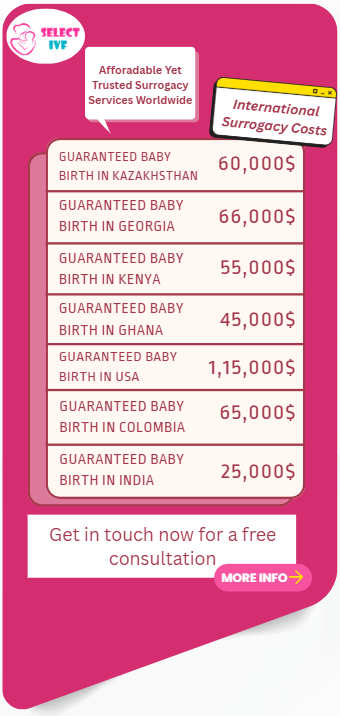
| Alternative surrogacy destinations | Cost of surrogacy for alternative destinations (USD) |
| Surrogacy cost in Georgia | Up to $50,000 |
| Surrogacy cost in Ukraine | Up to $40,000 |
| Surrogacy cost in Colombia | Up to $60,000 |
| Surrogacy cost in Mexico | Up to $50,000 |
| Surrogacy cost in the USA | Up to $1,50,000 |
| Surrogacy cost in Dubai | Up to $35,000 |
| Surrogacy cost in Kenya | Up to $32,000 |
| Surrogacy cost in Nairobi | Up to $35,000 |
| Surrogacy cost in Thailand | Up to $55,000 |
How to choose the best surrogacy centre in India?
Multiple points are essential to consider while selecting the best surrogacy centre in India, which are mentioned below:
It is advised to see the reputation and experience of a fertility centre in the fertility industry before choosing a centre for a surrogacy procedure. The reputation and experience build trust in the hearts of infertile couples.
Couples should look for a centre that comes with highly qualified fertility doctors who can ensure their success rate for surrogacy.
If your budget is tight and looking for a pocket-friendly then India will be the best option for those. In India, there are cities like Guwahati, Goa, Chennai, etc. Here, surrogacy services are affordable.
This is also one of the main factors that is crucial to look for in a fertility centre. A surrogacy centre with a high success rate can ensure you a successful treatment.
Surrogacy centres with good testimonials or positive reviews are the best options, as testimonials or reviews will help the person to get an idea about the services and quality of work of that fertility centre.
This is also important to get a better quality of surrogacy without worries. Check if the surrogacy centre provides legal assistance, and emotional and psychological counselling.

Why opt for Select IVF?
We understand how difficult it is to select the best option for your infertility treatment, but do not get tense, as one of the best options is going to be suggested to you, where the patient collaborates with highly experienced and qualified doctors. The patient will find it comfortable as the staff will always stand by them, away from all the worries that come to their mind. We offer all types of infertility treatment, so contact us today! To start, consider the following factors while selecting a location:
i. The patient-focused assistance of the centre
ii. Professionals with extensive education and experience
iii. Infrastructure that is well-built for maximum comfort and happiness
iv. The entire medical staff treats you with respect
v. Assists you throughout the entire process from the beginning
vi. Offers transparent fees and processes
You have the option of choosing surrogacy for all of these! So, reach out to us at +91- 8447592299 | Email ID: info@www.selectivf.com
Conclusion
Our article contains information about “Who Can Opction for Surrogacy in India”. It shows the different types of surrogacy available in India. The surrogacies that are available in India include gestational surrogacy and altruistic surrogacy. The surrogacies that are not available in India include traditional and commercial surrogacy. The ban emotionally, financially and legally impacted the intended parents. However, without help, you can choose the surrogacy that can help you in the dream of parenthood.
However, you have to follow some rules that are mentioned under the new surrogacy law in India. It states that couples must be married for 5 years, and their age must be between 23 to 50 years for females and 26 to 55 years for males. Moreover, must be indian citizens; if a foreigner, then they must have proof of indian citizenship like OCI cardholders or NRIs.
FAQs (Frequently Asked Questions)
What are the new rules for surrogacy?
The new law of surrogacy states that only altruistic surrogacy is allowed. This is the surrogacy in which the surrogate mother can’t get financial compensation except for medical expenses and insurance. Under this new law, only indian couples, married for at least 5 years, NRI, or OCI cardholders are allowed to get surrogacy. Their age for females must be between 23 to 50 years and 26 to 55 years for males. The age of the surrogate mother must be between 25 to 35 years, must have one biological child. This law also bans commercial and traditional surrogacy. Keeping surrogates and the intended mother safe, ensuring no exploitation.
Who is eligible for surrogacy?
Indian married couples who have been married for at least five years are eligible for surrogacy in India. However, this is not enough to get surrogacy in India. There are some more rules that need to be followed to get surrogacy in India. Intended couple’s age must be between 23 to 50 years for females and 26 to 55 years for males. 25 to 35 years for a surrogate mother. Couples must have an infertility certificate. Moreover, they must not have any biological children unless the child suffers from some kind of serious illness.
Can single men opt for surrogacy in India?
No, under the current surrogacy law of India, single men can’t opt for surrogacy.
What is the cost of a surrogate in India?
The cost of a surrogate mother in India is around 4 to 6 lakh. This cost covers the surrogate mother’s expenses, including medical, legal, travelling, accommodation, etc.
Is IVF or surrogacy cheaper in India?
Yes, both IVF and surrogacy are cheaper in India. Availability of skilled doctors and nurses, advanced medical facilities, and high success rates made surrogacy and IVF cheaper in India. Moreover, affordability doesn’t mean that you will get poor quality of infertility treatment. In India, you can enjoy both affordability and quality from the best IVF or surrogacy centre.
Read Also: